






When AI photography beats stock
Real or synthetic matters less than the job the image has to do.

Corporate photography has always had a credibility problem.
Not because the photos are fake. Because the meaning often is.
For years, companies have borrowed the same generic business image, then acted as if the page had become more believable. The result is familiar: a website looks finished, but the company does not feel any clearer.
This makes AI-generated corporate photography more interesting than the first reaction suggests. Synthetic images can feel hollow. We have all seen the version: too smooth, too glossy, somehow expensive and cheap at the same time.
Stock has a quieter problem. The scenes may be real, but they carry borrowed meaning.
AI flips the problem. Synthetic in production. Potentially much more specific in direction.
The image has to do a job
The real-versus-synthetic debate gets boring because it treats all images as if they have the same purpose.
They do not.
Some images act as evidence. They show a founder, a product, or a customer story. When the purpose is proof, use real photography.
Some images explain. In B2B, that often means a diagram, screenshot, or interface detail that makes a complex product easier to understand.
Some images create atmosphere. They give the brand a world to live in. This is where stock has been doing lazy work for a long time, and where AI becomes genuinely useful if the direction is strong.
Real or synthetic matters less than the job the image has to do.
This is also where old usability research still feels current. Nielsen Norman Group's eye-tracking work [cite:NN/g|https://www.netimperative.com/2010/11/08/web-users-ignore-generic-photos-online/|Netimperative summary of Nielsen Norman Group eye-tracking research on generic photos and user attention.] found that people ignore decorative stock photos, but pay attention to images that carry relevant information. That point matters even more now. A synthetic image is not automatically worse than stock. An image that doesn't add to any context is the problem, whatever produced it.




Proof should stay real
When a company needs proof of its people, culture, or process, do not invent it. Real photography carries texture and human details that are hard to fake well and often wrong to fake at all.
AI is not a replacement for the part of photography that proves something happened.
Much website imagery is mood and pacing. It supports the story around a product or service without claiming to document a literal moment.
For that kind of image, the question changes. Does it make the brand more specific? Does it belong on this website more than it would belong anywhere else?
Direct the atmosphere
The prompt is the wrong place to start.
The useful work is image direction, not the prompt.
Who is this for? What should the world feel like? What should never appear? Where will the image sit on the site? Does it need to carry a section, support a case story, or give a campaign a wider visual language?
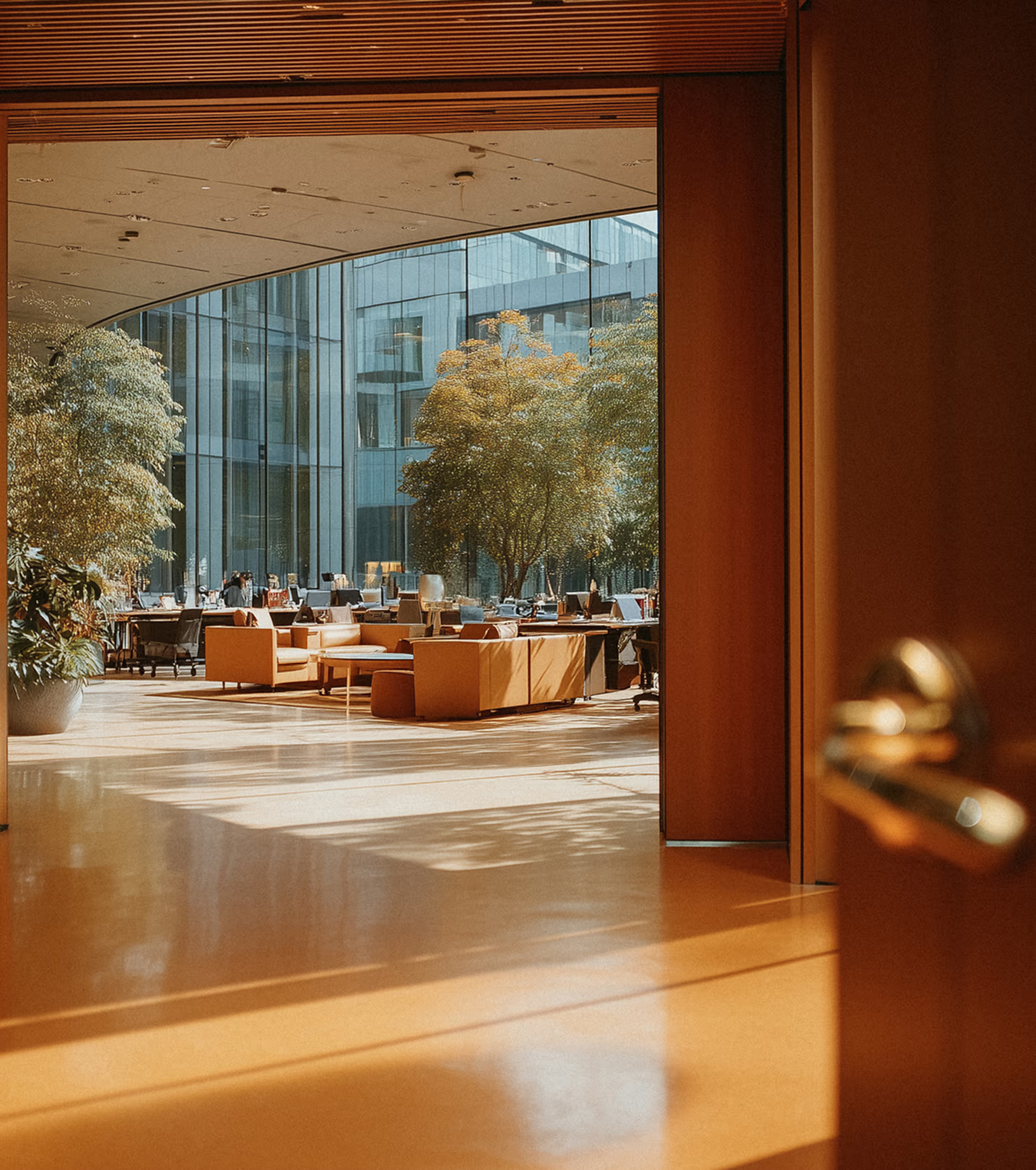
For Evooq, we explored generated photography as a way to build a broader visual world around the brand. The public case frames Evooq as a Swiss wealthtech serving private banks, asset managers, and pension funds. The images had to carry trust without sliding into cold finance cliches.
The site needed to explain a complex offer and make the brand feel more human. Random business images would have worked against that. We needed the images to feel like wealthtech without turning cold.
The images were not meant as documentary evidence of Evooq employees or a literal office day.
They can still feel more personal than stock because they serve a narrower world.

The middle path is an image system
AI-assisted photography sits between those options. It can create a controlled visual system around a specific mood, audience, and context. The images can vary without feeling disconnected. They can cover situations that would be expensive or awkward to shoot.
The value is not only that AI makes images cheaper to produce. Cheap images are everywhere.
The value is directional range.
For a B2B company, that might mean article visuals that do not look borrowed and campaign assets that sit naturally with the website.
Evooq as a useful case
For Evooq, the case describes a custom photography library built to feel corporate enough for a boardroom and warm enough to feel human. We used generated imagery to create a broader visual world around the site, from office scenes and city moments to portraits and quiet wealth-adjacent details.
Stock images often break down when you place them together. The page starts to feel assembled from leftovers.
A directed image library can behave more like a brand asset system. You can apply the same visual rules across places, people, crops, and moods.
The point was not volume.
The point was consistency.
Then comes the curation. Some images get rejected. Some need cropping or color work. Some are strong enough to become hero images.
That judgement is the service.

The standard should be higher
AI imagery often fails when the output is treated as finished way too soon. The output looks impressive for two seconds, then the cracks appear. The person feels wrong. The office looks too glossy. The brand disappears behind the tool's default aesthetic.
Good AI-assisted imagery needs a visual brief and a hard edit. A designer has to remove the almost-good images. AI gives you volume. Volume is not quality. It creates more decisions, not fewer.
For corporate photography, the standard should be even higher. A slightly wrong product mockup can look rough. A slightly wrong person can ruin the whole piece.
The question is not "can AI generate corporate photography?"
It can.
The better question is whether the image has a job, a point of view, and enough direction to earn its place.
A more useful image mix
This space interests us because it gives designers another production layer between borrowed stock and bespoke shoots.
Use real photography for proof, designed visuals for explanation, and AI-generated images for atmosphere at scale.
That is where AI photography can beat stock: not by pretending to be more real, but by serving the brand instead of borrowing from everyone else.
FAQs
Yes, when it is used for atmosphere rather than proof. AI-generated corporate photography can feel more personal than stock if it is directed around a specific brand world, audience, and context. It starts to fail when the image pretends to document real people or comes from generic prompt output.
No. Real photography is still the better choice when the image needs to show actual people, spaces, events, culture, or behind-the-scenes proof. AI-assisted photography is more useful for scalable brand atmosphere, campaign imagery, article visuals, and situations where a literal documentary image is not required.
It is useful when a B2B brand needs a broader visual system than a single photoshoot can provide. For example, it can support website sections, campaigns, articles, social posts, and sales material with images that feel connected instead of borrowed from unrelated stock libraries.
Generic AI imagery usually comes from weak direction. The signs are familiar: glossy offices, perfect lighting, vague people, and images that could belong to almost any company. Stronger results come from a clear visual brief, a defined image job, and a hard edit of the almost-good outputs.
Work with Oimachi